What it is.
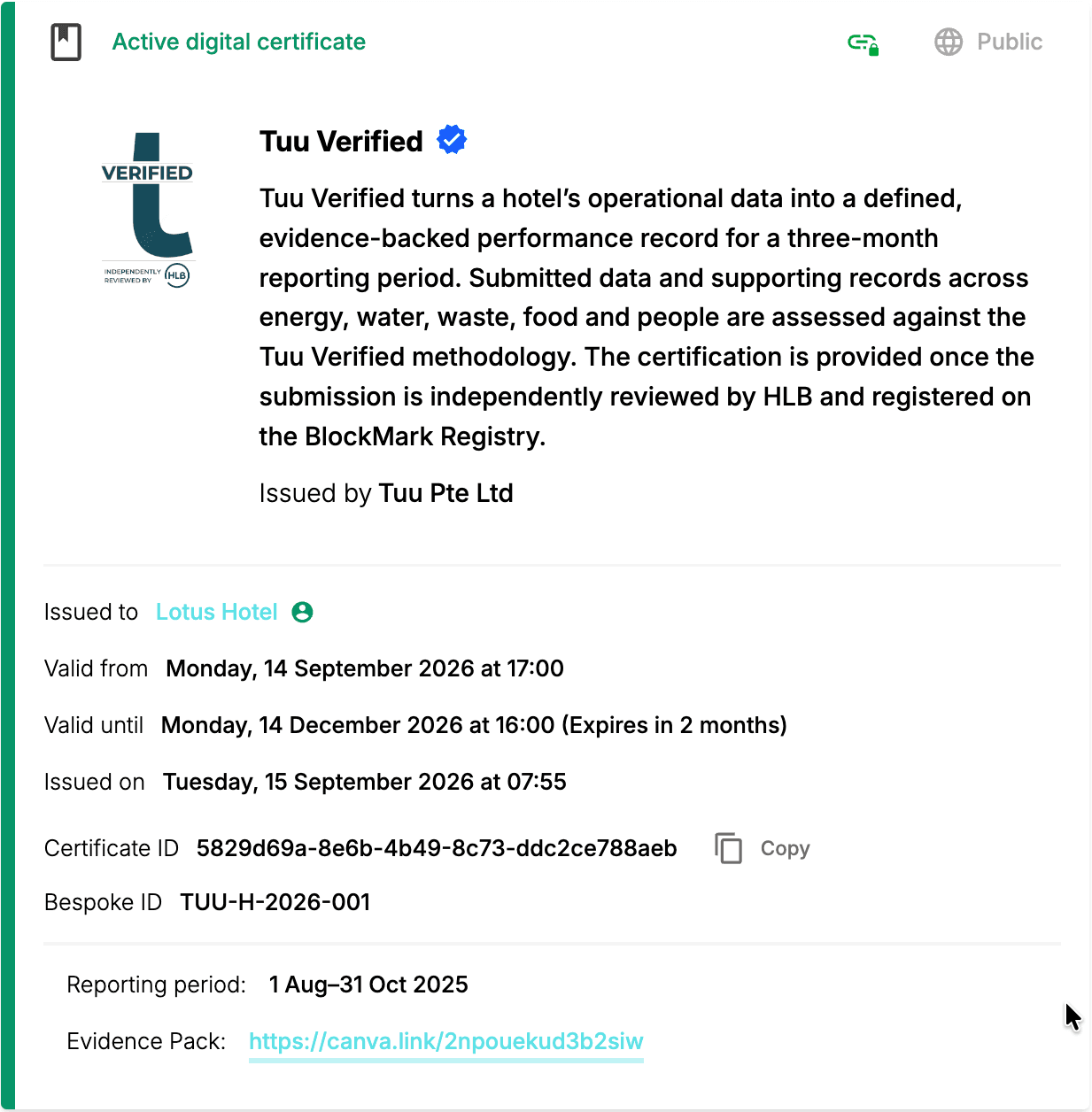
At the end of every quarterly cycle, once HLB has independently reviewed the figures and the documents behind them, Tuu issues the property’s record and registers it on BlockMark, an independent blockchain registry. The entry carries the property, the three-month reporting period, a certificate ID, a Tuu Record ID and a link to the Evidence Pack — served from infrastructure Tuu does not operate.
What a registered record looks like.
A live entry on the BlockMark Registry. Anyone with the Record ID can open it, check the period and the certificate ID, read the changelog and the blockchain log, and follow the link to the Evidence Pack.
Why this matters.
Most “verified” badges are PDFs hosted on the property’s own website. They can be edited, withdrawn or replaced at any time — by the property, by the issuing body, or by anyone with access to the file.
A registered record cannot. Once it is on BlockMark, neither Tuu nor the property can backdate, edit or revoke it. Every change is logged. A procurement reviewer, an owner or a booking platform that cites a Tuu Record ID is citing a public, independent record with a fixed period — not a hosted file.
About BlockMark.
BlockMark is an independent technology platform that records certifications and verification outcomes on a public blockchain. Its role is the registry layer: receiving, time-stamping and serving records issued by verification bodies. It does not perform verification and does not certify operational data. Tuu uses BlockMark because the recording layer has to sit outside the verification body to mean anything.
Visit BlockMark →